Balanced Transmission Technology Analysis

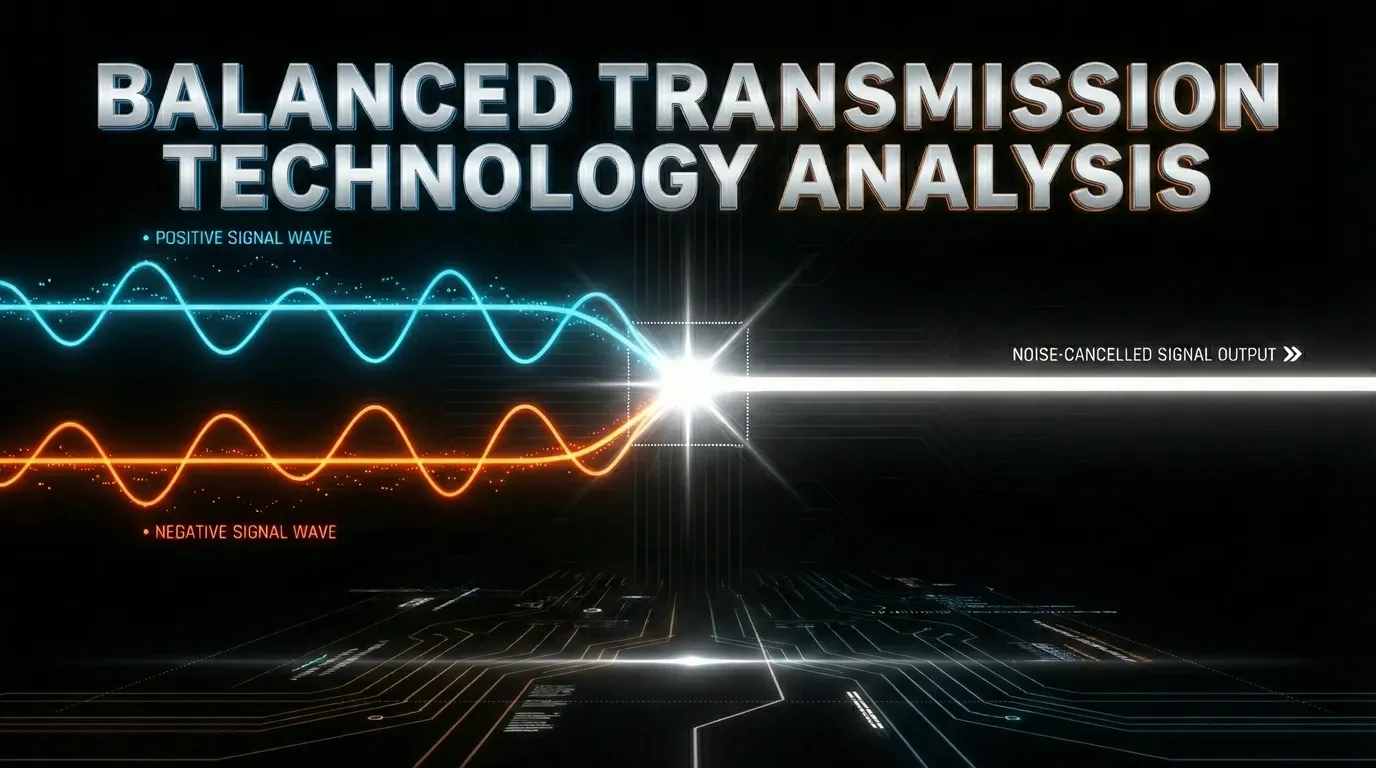
Cover art for Balanced Transmission: A Technical Deep Dive. Minimalist tech visualization showing symmetrical positive (cyan) and inverted negative (orange) signal waveforms converging to cancel out common-mode noise, resulting in a pure white output signal beam.

Unveiling the Core of Audio Transmission: Achieving High Noise Immunity with Balanced Systems

In professional sound reinforcement, recording studios, and live performance environments, Balanced Transmission is the de facto standard for audio cabling. Professional microphones (XLR), recording interfaces, and monitoring equipment (XLR / TRS) universally adopt this architecture. The fundamental reason lies not in the cost of the cable or the type of connector, but in the system’s inherent noise immunity at the circuit level.

Strictly speaking, it is not the “cable itself” that possesses noise-canceling capabilities, but rather the Balanced Signal System—comprising a balanced driver, a symmetrical transmission medium, and a differential receiver circuit. The core engineering mechanism behind this is Common Mode Rejection (CMR).

This article analyzes balanced transmission following the engineering cognitive sequence: from Physical Structure → Circuit Operation Principle → Practical Identification. We will explore how balanced transmission maintains a high Signal-to-Noise Ratio (SNR) and low distortion even over long distances and in high-interference environments.

1. Physical Layer: Fundamental Differences in Signal Reference Topology

To understand noise immunity, one must first clarify “what the signal uses as a reference point.” The difference between balanced and unbalanced transmission is fundamentally a difference in Signal Reference Topology, not merely the number of conductors.

1.1 Unbalanced Transmission

Unbalanced transmission is the simplest and oldest architecture, commonly found in TS instrument cables and RCA consumer audio cables.

  • Structural Characteristics:
    • Signal Conductor: Carries the audio voltage.
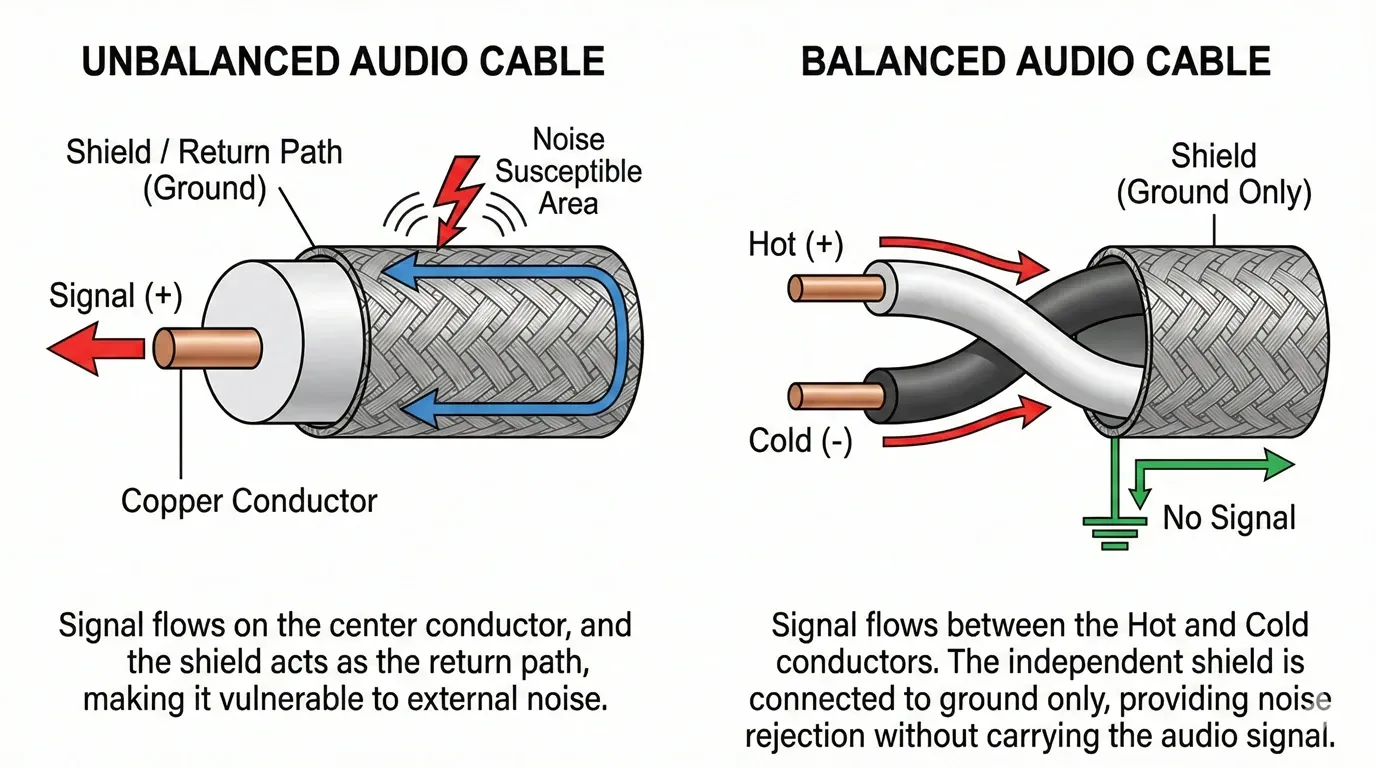
    • Ground / Shield: Acts simultaneously as the Signal Return Path and the electromagnetic shield.
  • Engineering Limitations:
    Because the ground conductor is part of the signal loop, any current induced in the shield by electromagnetic interference (EMI/RFI) directly modulates the signal reference potential. This results in noise voltage being superimposed onto the audio signal. In engineering, this phenomenon is known as Common Impedance Coupling.
    Consequently, the noise immunity of unbalanced transmission relies entirely on the shielding effectiveness. In environments with high impedance sources, long cable runs, or strong interference, the SNR deteriorates rapidly.

1.2 Balanced Transmission

Balanced transmission is the standard architecture for professional audio systems, commonly using XLR and balanced TRS interfaces.

  • Structural Characteristics:
    • Hot (+): Carries the in-phase audio signal.
    • Cold (−): Carries the anti-phase audio signal (or no signal, see Section 2.1).
    • Shield / Ground: Provides electromagnetic shielding and chassis ground reference; it does not carry the audio signal current.
  • Key Distinction:
    In a balanced architecture, audio information is defined entirely by the voltage difference between the Hot and Cold conductors, rather than a potential relative to the ground. The shield is responsible only for intercepting external interference and shunting it to the ground; ideally, it does not participate in signal calculation.
Diagram comparing the internal structure and signal flow of Unbalanced vs. Balanced audio cables. Illustration shows how the unbalanced shield acts as a return path creating noise susceptibility, while the balanced independent shield and twisted pair design provide noise rejection.

2. Circuit Layer: Impedance Symmetry and Common Mode Rejection

This is the most frequently misunderstood aspect of balanced transmission. The noise immunity of a balanced system is achieved through Impedance Symmetry and the Differential Amplifier, not simply by the voltage swing of the signal.

2.1 The Transmitter: Impedance Matching is the Only Key

At the balanced output stage, the core design requirement is that the Source Impedance of the Hot leg and the Cold leg (relative to the ground) must be perfectly matched. Regarding signal voltage symmetry, there are two common architectures:

  1. Active / True Balanced:
    • Hot: $+S(t)$
    • Cold: $-S(t)$
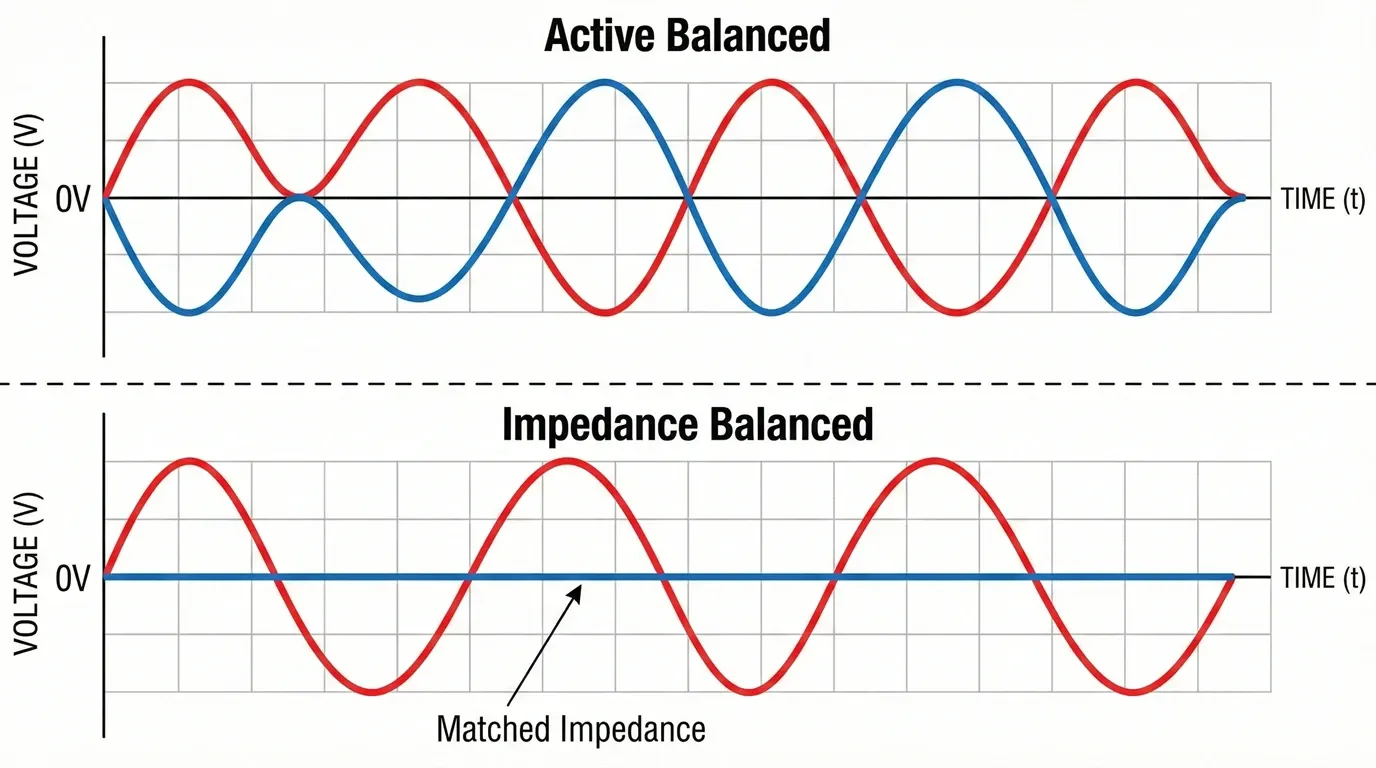
    • Both signals have equal amplitude but opposite polarity. This is the traditional high-end architecture, offering an additional 6dB of headroom.
  2. Impedance Balanced:
    • Hot: $+S(t)$
    • Cold: $0V$ (No signal, but connected to ground via a precision resistor)
    • Although the Cold leg carries no audio, its impedance to ground is designed to match the Hot leg exactly. Many modern professional interfaces and synthesizers use this design to reduce cost and circuit complexity.

Engineering Takeaway: Regardless of the architecture (Active or Impedance Balanced), as long as the source impedance is precisely matched, the noise immunity performance is equivalent.

Oscilloscope view comparing Active Balanced vs. Impedance Balanced signals. The bottom graph illustrates that Impedance Balanced outputs keep the Cold leg at 0V but maintain Matched Impedance for noise rejection.

2.2 The Transmission Medium: Formation of Common Mode Interference

In real-world cabling environments, external electromagnetic fields (power lines, lighting dimmers, RF sources) affect signal conductors via capacitive or inductive coupling.

Since balanced cables utilize a Twisted Pair structure and—as established in Section 2.1—both conductors have identical impedance to ground, external interference induces an equal and in-phase noise voltage on both lines. This is referred to as a Common Mode Signal.

2.3 The Receiver: Differential Amplification and Cancellation

The Differential Amplifier at the receiving end is sensitive only to the “voltage difference” between the two inputs.

Mathematical Verification:

Let the original signal be $S$ and the environmental noise be $N$ (where $N$ is equal on both legs due to impedance matching).

  • Scenario A: Active Balanced (Positive and Negative Signals)
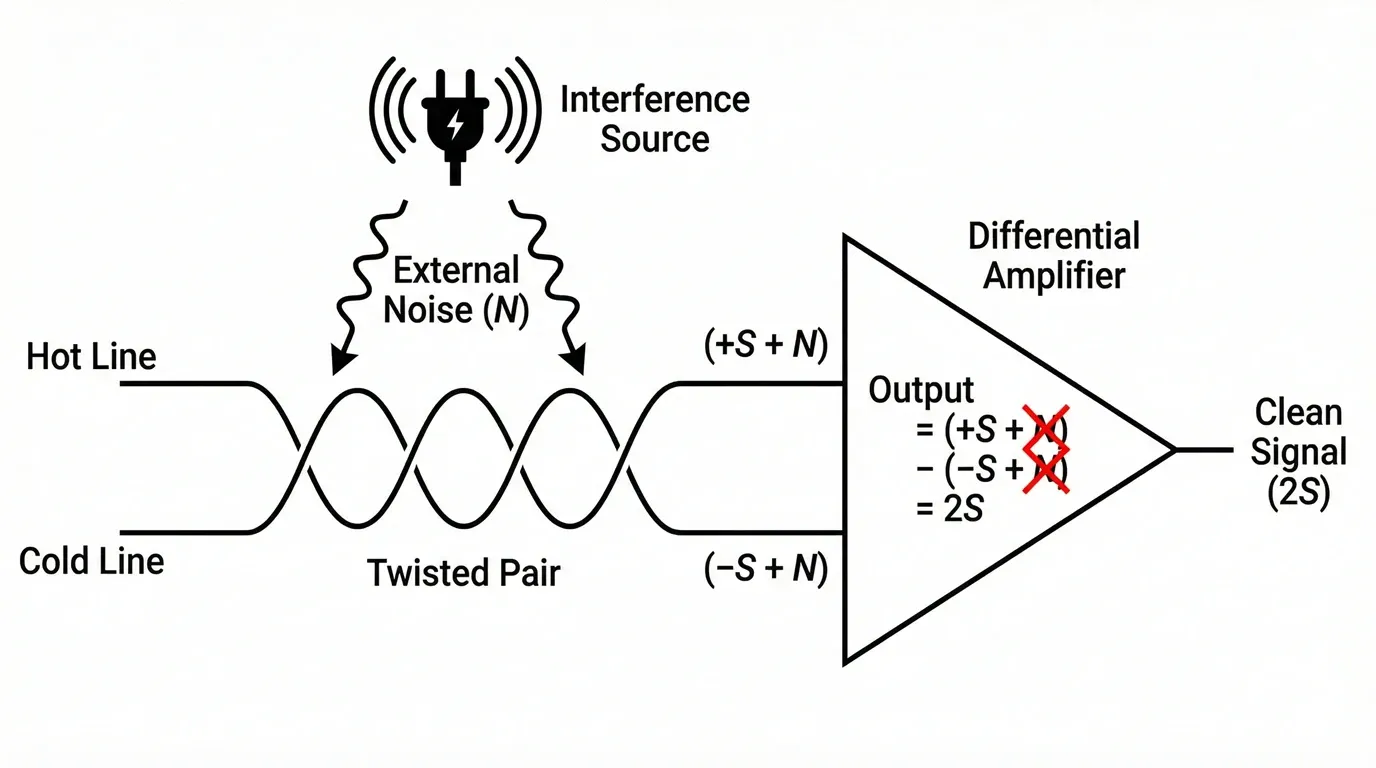
    Output=(+S+N)−(−S+N)=2S

(Result: Signal doubles, Noise cancels out)

  • Scenario B: Impedance Balanced (Cold leg has no signal)
    Output=(+S+N)−(0+N)=S

(Result: Signal remains unity, Noise still cancels out)

This proves that as long as $N$ is equal on both legs (i.e., impedance is matched), common mode noise is completely eliminated. The system’s ability to suppress common mode signals is expressed as CMRR (Common Mode Rejection Ratio), typically exceeding 60dB in professional equipment.

Diagram of Common Mode Rejection mechanism in balanced audio. Illustrating how a differential amplifier cancels out external noise (N) picked up by twisted pairs via subtraction, resulting in a clean audio signal (2S).

3. Practical Layer: Identification, Application, and Common Pitfalls

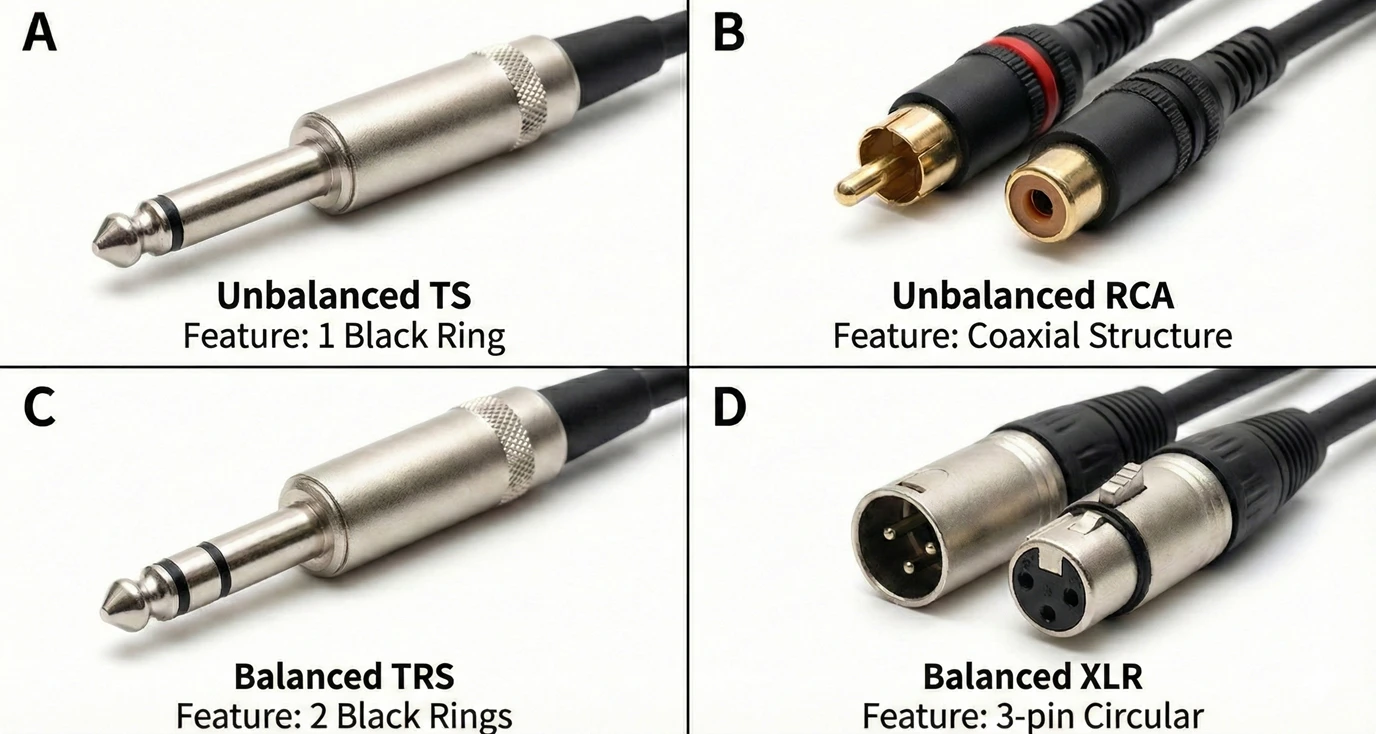
3.1 Connector Identification Guide

TypeFeaturesCommon ApplicationsNoise Immunity
Unbalanced TS1 Insulating Ring (Black)Electric Guitars, Mono SynthsNone
Unbalanced RCACoaxial StructureConsumer Audio, DJ TurntablesNone
Balanced TRS2 Insulating Rings (Black)Interface I/O, Studio MonitorsYes
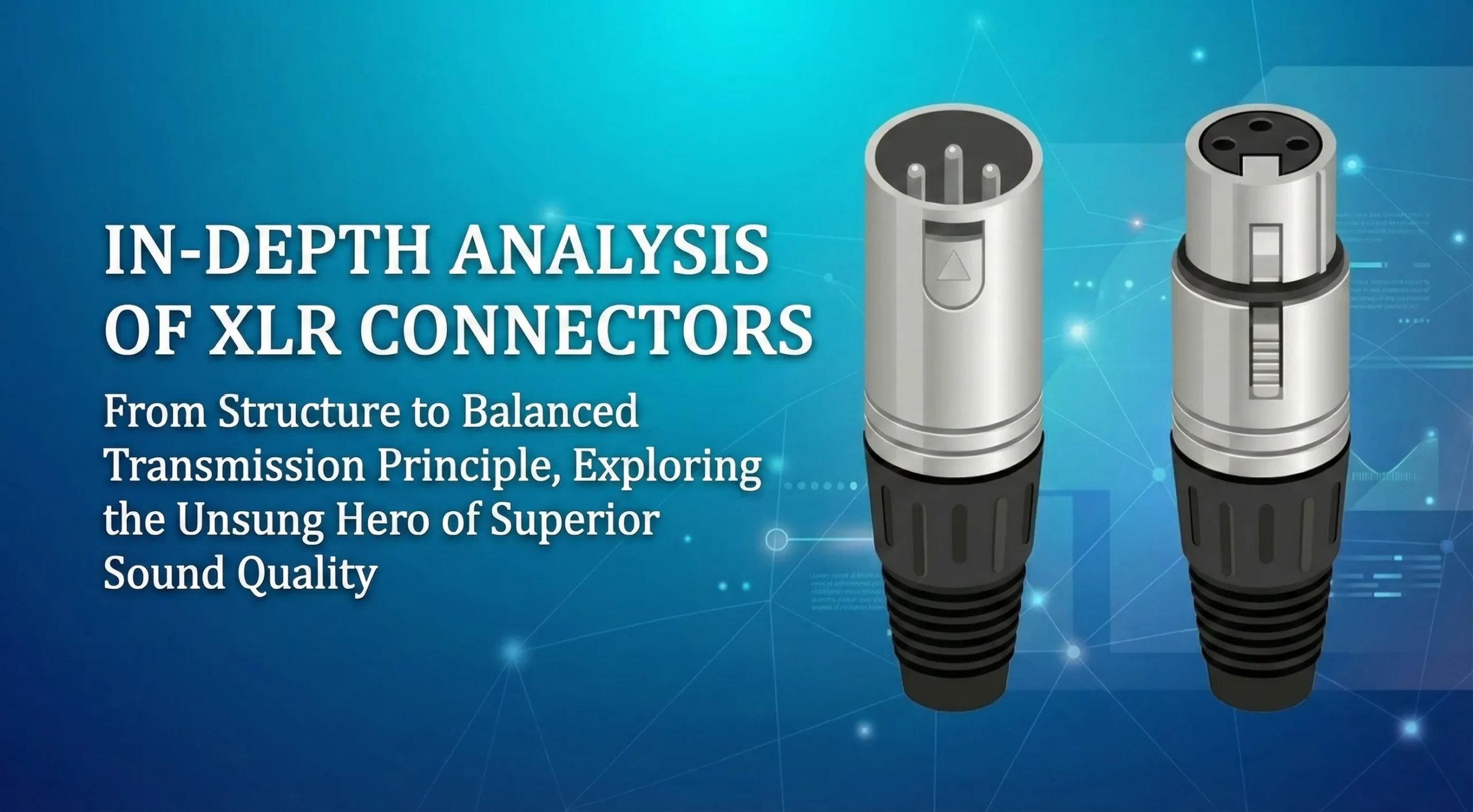
Balanced XLR3-Pin Circular with LatchMicrophones, Pro Audio SystemsYes
Visual identification guide for common audio connectors. Quadrants show Unbalanced TS (1 ring), Unbalanced RCA, Balanced TRS (2 rings), and Balanced XLR (3-pin) with key physical features labeled.

3.2 The TRS Engineering Trap

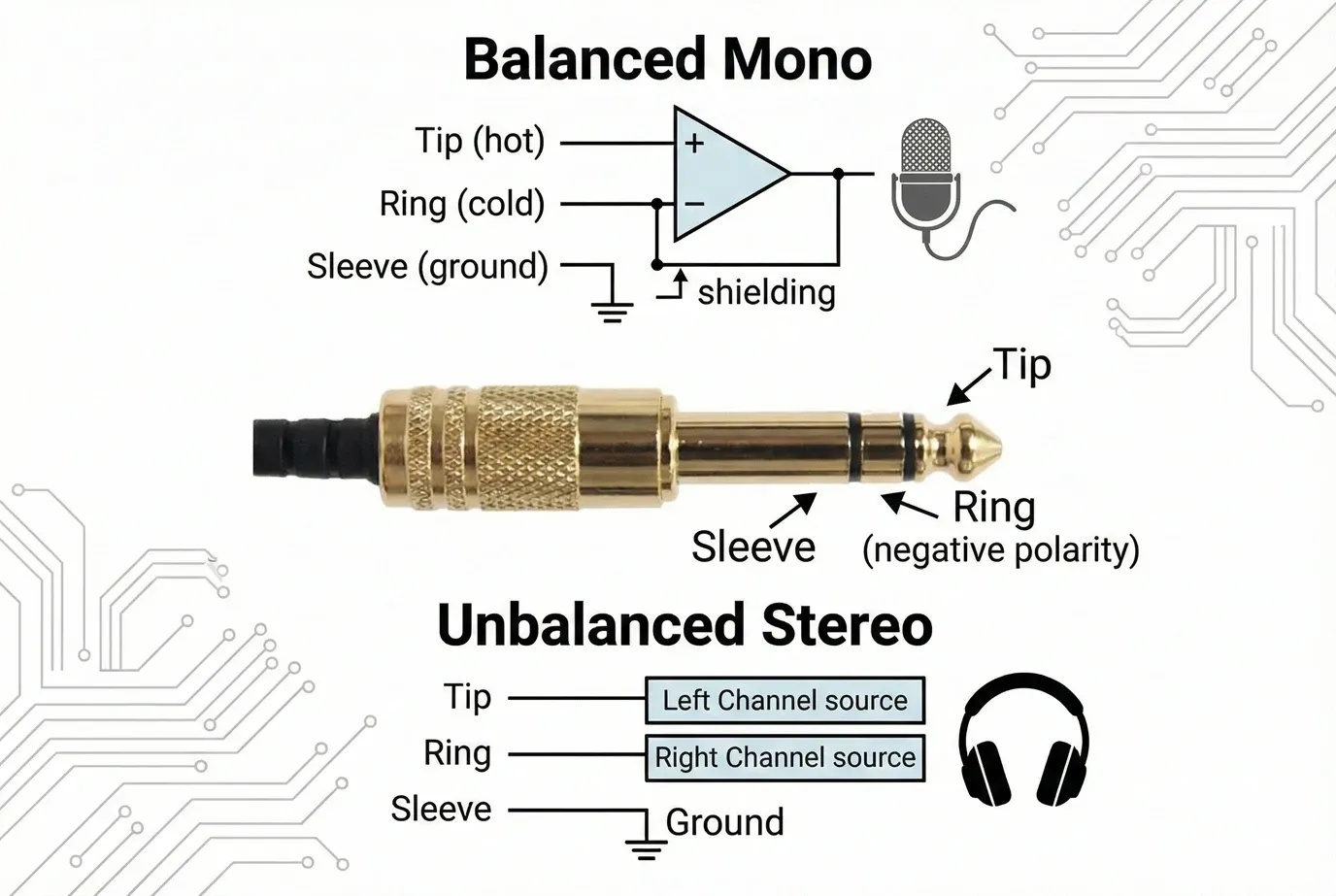
A TRS connector only indicates a “Tip-Ring-Sleeve” three-conductor structure; it does not automatically equate to balanced transmission.

  1. Balanced TRS (Balanced Mono):
    • Pinout: Tip (Hot) / Ring (Cold) / Sleeve (Ground).
    • Usage: Mono balanced transmission with noise immunity.
  2. Stereo TRS (Unbalanced Stereo):
    • Pinout: Tip (Left) / Ring (Right) / Sleeve (Ground).
    • Usage: Headphone jacks. This consists of two unbalanced signals sharing a common ground and possesses no noise immunity.

The key to identification lies in the equipment manual: look for labels specifying “Balanced Output” versus “Stereo / Headphone Output,” rather than relying solely on the visual appearance of the connector.

Conclusion

The value of balanced transmission lies not in the mystique of the cable itself, but in the comprehensive system design comprising a Symmetrical Source, a Symmetrical Transmission Medium (Cable), and a Differential Receiver (Load).

By converting environmental interference into a mathematically cancellable common mode component, balanced transmission systems maintain a high Signal-to-Noise Ratio and stable dynamic range even in long-distance runs and high-EMI environments. Therefore, whenever equipment supports true balanced input and output, prioritizing balanced transmission remains the most direct and reliable engineering solution for professional recording, stage cabling, and complex electromagnetic environments.