Introduction
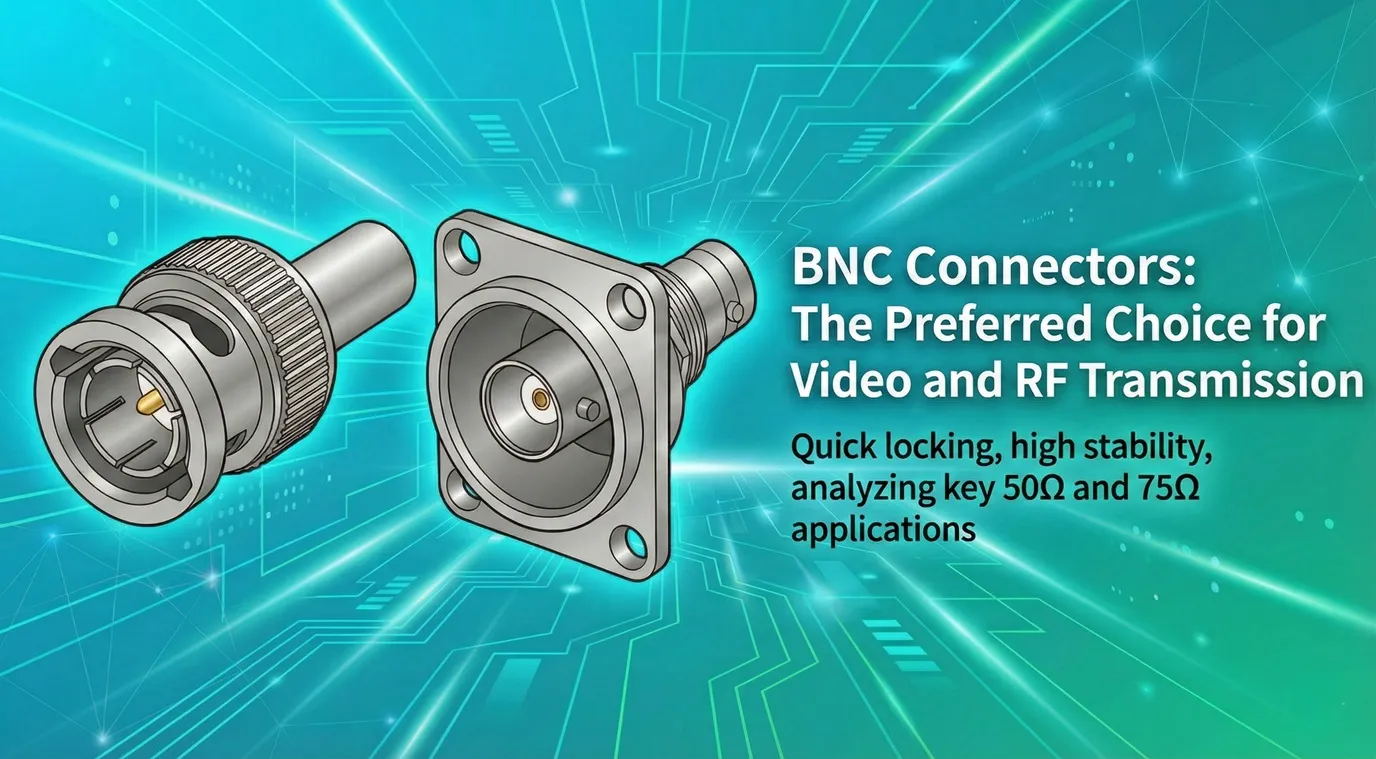
The BNC connector (Bayonet Neill–Concelman) is a widely adopted radio‑frequency (RF) coaxial connector used throughout professional electronics, broadcasting, surveillance, and test‑and‑measurement industries. Its enduring relevance is driven by three core attributes: controlled impedance, mechanically secure bayonet coupling, and predictable high‑frequency performance.
Within its intended operating range, the BNC connector provides a robust and repeatable interface for both analog and digital signals, serving as a long‑established industry reference standard rather than a mere consumer‑grade interconnect.
Key Engineering Advantages
1️⃣Controlled Mechanical Retention:
The bayonet coupling provides a repeatable locking force superior to friction‑fit connectors. This reduces intermittent contact issues in environments subject to movement or vibration.
2️⃣Rapid Mate and Demate:
The tool‑free connection mechanism makes BNC connectors ideal for laboratory instrumentation, patch panels, and field service applications.
3️⃣Defined Characteristic Impedance:
BNC connectors are manufactured to maintain a specified characteristic impedance—most commonly 50 Ω or 75 Ω—to minimize signal reflections (VSWR) and insertion loss when properly matched with the system.
Technical Distinction: 50 Ω vs. 75 Ω BNC Connectors
Although they share the same shell design, 50‑ohm and 75‑ohm BNC connectors are electrically and mechanically distinct.
| Parameter | 50 Ω BNC | 75 Ω BNC |
|---|---|---|
| Nominal Impedance | 50 Ω | 75 Ω |
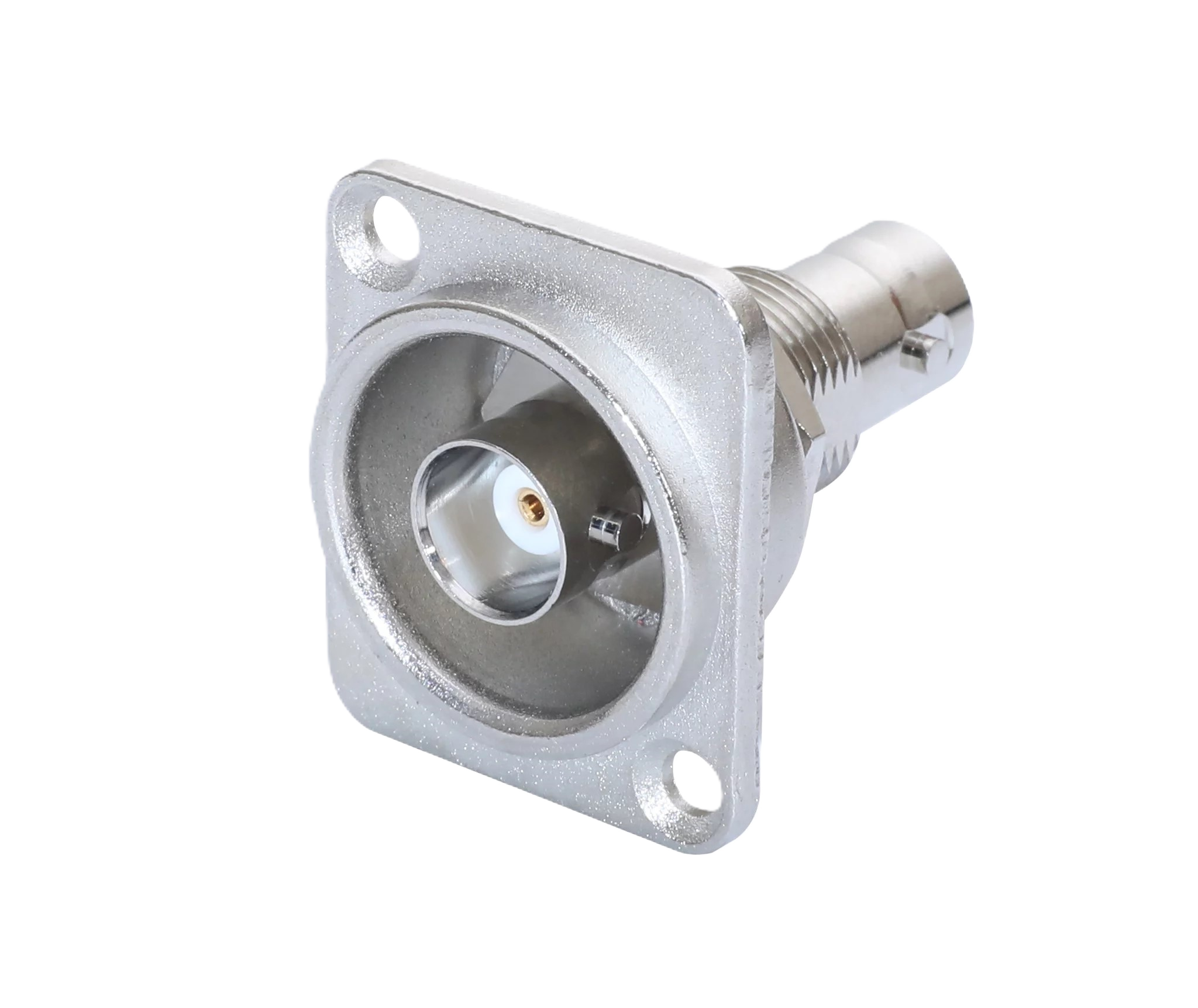
| Visual Identification | Dielectric (white plastic) visible at the interface surrounding the center pin. | No dielectric (air gap) surrounding the center pin at the mating interface. |
| Center Conductor | Relatively larger diameter. | Relatively smaller diameter. |
| Typical System Focus | Power handling and broadband RF data. | Low-loss video and high-bit-rate digital signals. |
| Common Applications | RF instrumentation, Oscilloscopes, Signal Generators, Wireless Comms. | 12G-SDI / 4K Video, CCTV, Broadcast Infrastructure. |
⚠️ Engineering Note on Compatibility
While 50 Ω and 75 Ω BNC connectors are generally physically mateable, mixing them is considered poor engineering practice for two reasons:
- Electrical Discontinuity: The impedance mismatch causes signal reflection (high VSWR). In digital video (SDI), this leads to jitter and data errors; in RF, it creates return loss.
- Mechanical Risk: In precision or metrology-grade equipment, the dimensionally larger center pin or dielectric configuration of a 50 Ω plug can permanently damage the contact fingers of a precision 75 Ω socket. Always match the connector type to the device port.
Frequency Performance Considerations
Standard commercial BNC connectors are typically specified for operation in the DC to 4 GHz range. While this covers the vast majority of video and general RF applications, performance depends heavily on manufacturing precision.
- Standard Grade: Suitable for up to 4 GHz.
- Precision Grade: Some manufacturers offer precision BNCs rated up to 12 GHz or 18 GHz, though these are specialized.
- For applications requiring robust performance above 11 GHz in high-vibration environments, engineers typically migrate to TNC connectors.
Common Application Domains
1. Broadcast and Professional Video
This is the domain of 75 Ω BNC connectors. They are critical for Serial Digital Interface (SDI) standards, supporting uncompressed digital video transmission from SD-SDI up to 12G-SDI (4K UHD) with strict impedance control.
2. Video Surveillance (CCTV)
BNC connectors remain the standard interface for analog and HD-over-Coax surveillance cameras, utilizing 75 Ω cabling to ensure artifact-free video transmission.
3. Test and Measurement
Oscilloscopes, spectrum analyzers, and function generators almost exclusively use 50 Ω BNC interfaces as the universal laboratory standard for probe connections.
Frequently Asked Engineering Questions
Q1: Are BNC connectors suitable for 4K digital video?
Yes. High-quality, true 75-ohm BNC connectors designed for broadcast (often labeled as 12G-SDI compliant) are specifically engineered to handle the high bandwidth required for 4K Ultra HD signals.
Q2: What distinguishes BNC from TNC connectors?
TNC (Threaded Neill–Concelman) connectors are mechanically similar to BNC but replace the bayonet lock with a threaded coupling. This improves stability, reduces RF leakage, and typically extends the frequency range up to 11 GHz.
Q3: How are BNC connectors terminated onto cables?
- Crimp: The industry standard for production, offering high repeatability and mechanical strength.
- Compression: Popular in the CCTV installation market for its water-resistant properties and ease of field termination.
- Solder: Less common in modern volume production but offers excellent electrical conductivity when performed by skilled technicians.
Conclusion
The BNC connector remains a technically relevant and reliable interface when applied within its intended electrical and mechanical limits. Correct selection between 50 Ω and 75 Ω variants, combined with proper cable matching, is essential to maintaining signal integrity.